FRESHLY CUT TO ORDER   ·   NATIONWIDE DELIVERY   ·   EXPERT ADVICE

Weeds, Coarse Grasses & Clover - Lawn Problems (5)

If you’re not careful, your lawn may be invaded by weeds, including coarse grasses, clovers, and daisies.

If you can clearly distinguish different types of grass in your lawn turf, you probably have coarse grasses present. Your lawn may have patches of grass that grow at different rates, or perhaps have a ‘peppered’ look, which means annual meadow grass is present. These grasses may have arrived as seeds spread by birds, or perhaps in unsterilized topsoil used for top dressing. They can easily take over during winter, when lawn turf tends to stop growing, but these coarse grasses continue.
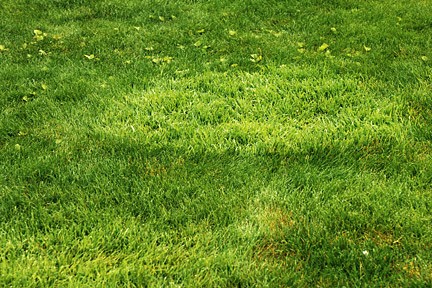
large lawn care coarse grasses

What can you do to get rid of coarse grasses? Well, the good news is that you’ll be doing many of the ideal controls already as part of your regular lawn care. Applying a nitrogen-rich fertiliser in March, which is anyway a good way to get your lawn going, will boost the grasses that you want to encourage, at the expense of the coarser species. Regular mowing weakens coarse grasses, as they are not adapted for this treatment. Before mowing, rake gently over the coarse patches, to lift the grasses and make mowing more effective.

You can also dig out individual patches of coarse grass by hand, if they have not spread too far. You may even find that you need to dig out large patches in September or October and reseed or buy turf to fill the gaps. ( click here to buy turf online)

You may also get other weeds, such as clovers, trefoils or daisies, in your lawn. Some gardeners may not consider this an issue, but instead, a desirable addition to the lawn that will be beneficial to insects. If you can take this approach, it will certainly make your life easier! However, if you feel you have to rid your lawn of weeds, read on.

To remove daisies altogether, you will almost certainly need to dig them out, using a long straight trowel or dandelion remover, to ensure that you remove all the root. Clovers can survive heavy mowing, and spread to form large colonies, which may even take over the lawn in some areas. If you spot clovers early enough, you can dig out individual plants or small colonies, and remove them by hand. Applying lawn fertiliser regularly will also strengthen grass, and help it to out-compete the weeds.

If the weeds have spread too far to dig out, you will need to buy a specific lawn herbicide. If the one you choose is not successful, look for one that is specific to your weed species, as many species are resistant to certain herbicides. But with time and effort, you should be able to remove all the weeds.
Autumn Lawn Care

How should you care for your lawn as autumn approaches? September is the best time to treat your lawn for all kinds of problems. Follow this easy how-to guide, and your lawn turf will be set up for spring next year! 

autumn-lawn-care

1. Stop feeding

Yes, really. It’s time to stop applying summer fertiliser to your lawn now. Any more nitrogen-rich feeding will encourage soft growth that will be prone to infections as well as frost damage.

2. Scarifying

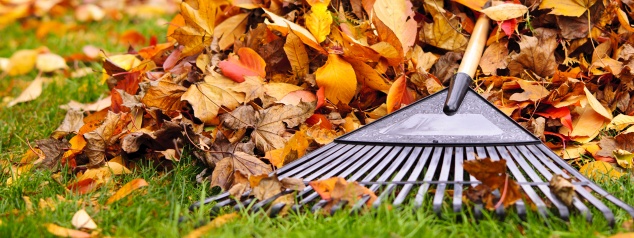
Scarifying means raking your lawn, either with a lawn rake, or an electric scarifier. This will remove the thatch, the under-layer of grass, which consists of dead grass, moss and so on. Its removal will allow light and moisture to get to the grass roots, making it healthier. (Do not scarify newly laid lawns)

3. Aerating/spiking

Spiking your lawn with a garden fork at regular intervals improves the drainage, which in turn improves the health of the lawn turf, and makes it less likely to succumb to fungal diseases. If your soil is very heavy or waterlogged, it is worth using a hollow-tine aerator every few years, to remove plugs of soil, and really make sure the water can drain.

4. Top dressing

The Royal Horticultural Society recommends top dressing in autumn with a mixture of three parts sandy loam, six parts sharp sand and one part compost or leaf mould, at a density of 2-3kg per square metre, worked in well with the back of a rake. This will help improve the soil, and encourage strong roots.

5. Correcting lumps and dips

If your lawn suffers from large dips and bumps, now is a good time to sort that out. Use a spade or an edging tool to slice through the turf in the dips and gently lever it back. Loosen the soil underneath, and then add more topsoil where necessary to fill in the dip. Carefully replace the turf, pressing down the edges, and water it to encourage the roots to grow.

6. Re-turf any struggling areas

You can buy turf from turf suppliers in small amounts for patching, and it is well worth doing this now, before winter, to give your new turf a chance to establish itself over winter. Have a look at our quick guide to patching for more advice.

So there you have it, a quick guide to autumn lawn care. Not all of these tasks will be necessary every year, by any means, but  most lawns will benefit from all of them sooner or later. If you bear this list in mind during September, and be ready with the tools if your lawn looks like it could do with a helping hand, then your grass will reward you richly come spring and summer next year. 

Lawn Problems | Part 4 - Dry Patch

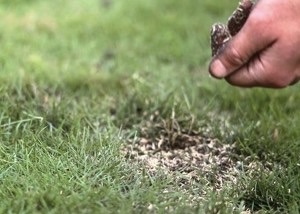
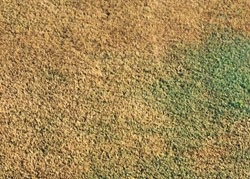
This is a simple name for a complex problem. Dry patch describes a condition where the soil in your lawn becomes water-repellent in patches (or hydrophobic), causing patches of brown, dead grass. No matter how much you water, or it rains, the ground in the patches remains absolutely dry. The causes are complex and not well understood, although one contributing factor is thought to be fungi coating the soil particles with water-repellent chemicals. Although not generally pathogenic and damaging to the plants themselves, they can nevertheless cause a major problem to the lawn as a whole.

lawn-problems-dry-patch

How will you know if the cause of dead patches in your lawn is dry patch? The patches generally turn darker green first and then brown., but the real giveaway is that the symptoms develop in dry weather, but don’t improve when you water, or when it rains. And when you look at the affected area, you will find that the soil under the patch is absolutely dry. If you water it, the water will simply run off. You may even find that puddles form when it rains, but the soil remains bone-dry underneath. If you dig down in the roots, you may sometimes see fungal mycelium, or smell a fungal smell in the soil, but this is by no means always the case.

The best forms of control are good and regular maintenance of your lawn turf (see our turf range here). This includes scarifying (raking hard with a lawn rake or electric scarifier) in the autumn to improve aeration and remove thatch. Again in the autumn, you should improve drainage and help to prevent compaction by spiking the lawn with a garden fork or hollow-tine aerator. Regular feeding at the recommended intervals will promote strong healthy growth of grass with a good root system, which will make dry patch less likely.

If you do have dry patch, there are various ways to try to re-wet the soil, although it is very difficult. You can try spiking the area densely, and water it a little every day for a few days. There are ‘wetting agents’ available, which are chemicals that help the soil particles to absorb water. These are often used by professionals, but there are some available for domestic gardens. More than one treatment is likely to be necessary. Finally, if all your treatments, repeated over several months, are ineffective, you will need to remove the affected turf plus three or four inches of soil below, and replace it. You can buy good quality turf from turf suppliers to patch a reasonably small area, or fill in the soil with new topsoil and seed, if the area is quite small. Advice on patching a lawn can be found in our article on whether to seed or turf.

Lawn Problems | Part 3 - Red Thread

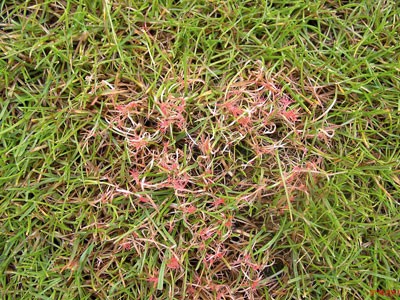
The previous article on lawn problems mentioned that patches can often be caused by lawn diseases. One of the most common is the fungus red thread (Laetisaria fuciformis), which generally develops in late summer or autumn, especially when the weather is wet.  Red thread usually develops on grass that is badly aerated and low in nitrogen. Even if you regularly apply nitrogen, heavy or prolonged rain may wash it away.

The patches caused by this fungus often appear reddish at first, although they will later turn to lighter brown or look bleached. The patches are usually between 7.5cm and 25cm, although they can be bigger.

Red Thread

If you’re still in doubt about whether you have red thread, take a closer look with a magnifying glass. You will generally see two types of fungal growth, one which is small, pink and cottony, and can look similar to the fungus causing snow mould. The second gives red thread its name: pinkish-red gelatinous ‘threads’ 1-2mm long, which form on the leaves, and can bind them together. They are often visible with the naked eye, especially in humid conditions.

The good news is that red thread doesn’t very often kill grass, as it doesn’t attack the roots. So your lawn turf will recover quickly with appropriate treatment. You should apply nitrogen to the affected area, in the form of ammonium sulphate, at 15g per square metre. Do not apply after August, as you will encourage growth which will be prone to other moulds and diseases.

If it is too late to apply nitrogen, or nitrogen was ineffective, you can try using a fungicide. The only one currently available for domestic use is trifloxystrobin (Bayer Garden Lawn Disease Control). You can use this at any time of year, unless it is very dry or the ground is frozen, but you should not use it more than twice a year.

There are lawn maintenance companies who can treat with fungicides licenced for professional use. However, the Royal Horticultural Society advises that there is strict legislation about what professional products can be used in domestic gardens, so you will need to make sure that the company is operating legitimately in applying chemicals to your lawn.

The best treatment for red thread is prevention, by applying nitrogen and improving drainage. Scarifying with a lawn rake will remove moss and dead grass, and allow more air to the roots. You can improve drainage by making holes with a garden fork or a hollow-tine aerator.

Finally, if you have had red thread, dispose of the grass cuttings from your lawn without composting, as this will help to prevent reinfection. Spores can live dormant for up to two years. 

If you do need to patch your lawn you can buy turf or use seed, see our article on the pros and cons of both these options.

Lawn Problems | Part 2 - Dead Patches

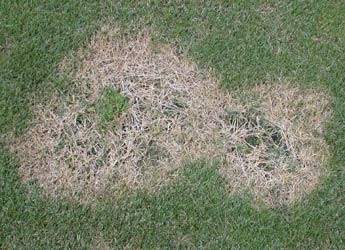
Brown, dead patches can appear in any lawn, and are a very common problem. Fortunately, it’s usually possible to identify and treat the cause, and therefore cure it. There are a number of causes of dead patches.

First, when did your patches appear? If after mowing, they may be due to spilt oil or petrol, which can kill lawns. Avoid topping up your petrol or oil on the lawn, and do not overfill tanks. Alternatively, if you have a few high spots, they may be getting ‘scalped’ by the lawnmower, and you may need to raise the height of the blades a little.

If they appeared during dry weather, and are generally near trees, or in sandy areas, then the patch is probably due to lack of soil moisture. Water the area thoroughly every week to ten days during dry periods, and it should recover.

large summerpatch

If they appeared after feeding  or applying mosskiller to the lawn, the fertiliser or weedkiller may have been too concentrated. Ideally, you should feed just before rain, or water the fertiliser in to prevent any problems. You may also have problems if you have used weedkiller on paths, and it has been walked onto the lawn. Try to avoid walking on the lawn just after spraying, or cover your shoes with plastic bags if you have to do so.

If you have got a dog, and the patches have bright green margins, they may well be due to the dog weeing on the grass. Female dogs’ urine in particular can damage lawn turf. Try to prevent your dog from weeing on the grass, but if you see it happening, water the area thoroughly as soon as possible.

If your house is a new-build, the dead patches may be due to buried builders’ waste, or soil compaction caused by machinery. The bad news is that you will need to dig out the waste or rubble, and dig over the compacted soil before you relay or reseed the lawn or patch.

If your dead patches are spreading rapidly, and you have noticed birds pecking at the lawn, you may have insect grubs feeding on the roots, probably leatherjackets or chafer grubs. You can buy nematodes for chafer grubs, or just wait until they have turned into adults and patch up the damage. Finally, if you have ruled out any other cause, rapidly-spreading dead patches may also be caused by lawn diseases, which generally occur in wet or damp weather. The precise treatment will depend on the disease and is out of scope of this article.

What can you do to treat dead patches? Well, you can reseed or buy turf to fill patches, and we have an article on patching lawns to help you.

Lawn problems | Part 1 : Moss, lichens & algae

Why do problems occur in lawns, and what can you do about it? In this series of articles, we plan to provide information about common problems, what causes them, and what you can do to prevent or cure them. The first in the series is about moss, lichens and algae.

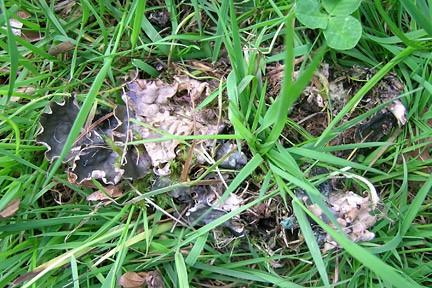
Lichens, algae and liverworts can appear in lawns in shady patches, especially if the drainage is poor, as they like the cool, damp conditions. Compacted soil seems to be especially prone to growth, so the drip line of trees can be a problem area.

What can you do about it? Well, there aren’t many chemical controls specific to algae or lichen, but fortunately, lawn mosskillers containing ferrous sulphate will also kill off algae and lichen. But actually, if you sort out your drainage problems, you should see your algae disappear as well.

large lichen in turf

If it is the top layer of the lawn turf that seems to be poorly drained, then spike it with a garden fork or aerator every 10-15 cm. If the compaction or waterlogging is only in patches, aerate the patches during wet weather every four to five weeks. On heavy clay soils, a hollow-tine aerator will be more effective than a garden fork. If your lawn remains waterlogged, you might have to consider installing an artificial drainage system.

After aerating, top dress with sharp sand, which you can buy from garden centres. This will improve the drainage. Try to avoid walking on the lawn when it is wet, as this will increase compaction. At the very least, take different routes across it! And finally, but most importantly, make sure that you carry out your routine maintenance, especially in the autumn, to keep your lawn turf healthy.

Moss tends to grow when the grass isn’t growing. So conditions that stress the grass tend to favour moss. Oddly enough, that includes both drought and waterlogging, but can also include wear and tear such as along paths, or shade. You can treat the moss, but if you don’t sort out the conditions that caused the grass to stop growing, it will recur again.

To treat the moss, you can remove it by hand, using a spring-tine rake, in the autumn. This process is called scarifying, and if you have a large lawn, you can hire a mechanical scarifier to help. You can also treat it with moss killer, several of which are available to buy. It may also be helpful to use a fertiliser mixed with moss killer, to encourage the grass to grow back as well. The time to use a moss killer is spring, which fortuitously is also a good time to feed the lawn, or early autumn, when you need to use the moss killer alone to avoid encouraging too much growth before the winter frosts.

Caring for your lawn in late summer

After the recent hot, dry weather, many of us are currently staring in dismay at a poor dried out brown area that used to be a beautiful lawn. But surely now is not the time to embark on extensive repair? What about if it’s dry throughout August too? So what can we do to keep the lawn going for the rest of the summer?

First of all, and most importantly, don’t stop mowing! Yes, we know that the lawn is very short and seems to be suffering. But do keep mowing, albeit with the blades set a little bit higher than usual. This will ensure that light and what little moisture is available continue to get through to the roots and keep the grass healthy. You can, however, leave the clippings behind and not collect them if you like, to act as a mulch to retain moisture.  However, they will need to be raked out come the autumn, so you may feel that this is going to make work later.

large summer lawn care

You should also continue to feed your lawn throughout August, stopping in late August or early September. Use a feed sold as a spring and summer feed, as this will provide suitable nutrients to keep your lawn growing, and follow the instructions on the packet about application, watering in and so on. The reason why you stop after late August is that you don’t want to encourage the lawn to grow tender new growth that will then be susceptible to any early autumn frosts.

And finally, the part you’ve all been waiting for: watering. Lawns are incredibly tough. No, really they are. Lawn turf will recover astonishingly quickly from a summer’s drought as soon as the rain starts again. And just at the moment, we seem to be having dry periods followed by heavy rain. So you may find that you can get through August and early September without having to water your lawn at all.

But since there’s no hosepipe ban, you may feel that it would be best to water, especially if you had to buy turf to lay last winter. If so, don’t water too often. Too much water makes the grass much less drought tolerant in the long term, as it encourages shallow root growth. Instead, water once every week to ten days, and leave your sprinkler on only for about 10 to 15 minutes per area. This should be enough to soak the ground down to 12cm, the depth recommended by the Royal Horticultural Society, and ensure that the roots have access to water.

And finally, whatever happens, don’t panic. Your lawn will probably recover, and if it doesn’t, there’s always patching!

Turf vs Seed: Patching Lawn Turf

If your lawn has suffered over the summer, and has some bare patches, maybe under a tree, or where the children have been playing, you will need to repair them. But what is the best way, seed or turf?

Apparently some people reseed their whole lawn every year. And certainly doing so could avoid a range of problems, including different coloured patches. It also re-establishes your original mix, and prevents the coarser grasses out-competing the finer ones and taking over. But even if you don’t really want to bother with that, and just want to repair one patch, then seeding can still work quite well.

patching-lawn-turf

There are a range of different seed mixes available, so try to buy one to suit the patch. For instance, if it’s right in the middle of your children’s football pitch, you’ll need a hard-wearing mix! If under a tree, try to find a shade-tolerant one. Once you’ve got your seeds, you need to cut out the old turf, using a half-moon edging tool if you have one. Use a fork to loosen the ground below, and add some top soil or potting compost to give your seeds something to grow in, and bring the level up a bit closer to that of the rest of the lawn. Sprinkle over the seeds according to the packet instructions. Cover with more topsoil, and water in with a sprinkler or fine rose. You’ll probably need to cover the seeded area with a net to keep off birds, pets and children. And do keep the net on until the grass has really started to grow!

A suitable alternative to seeding is to re-turf the patch. You can buy good quality turf from turf suppliers, and it is available in quite small quantities for patching. If you know what lawn turf was used originally, you can try to buy the same type, so that you won’t end up with differently-coloured patches. 

As with the seeds, you need to cut out the worn area of turf, and loosen the soil underneath with a fork. Cut an identically-sized piece of turf from your new turf – use the old piece as a template if you can – and place it into the space left behind. Top-dress with lawn sand, filling in any gaps around the edge of the turf. Press down the edges gently with your foot to secure it in place, and water in. Try to avoid walking on it for a few days, to give it a chance to root, but you don’t need to leave it quite as long as with seeds.

So you see, to seed or to turf is the question, but the answer is up to you.

How to Look After New Turf

New turf is in some ways comparable to a new pet or a new family member. It needs a lot of TLC in the early days and must be maintained to make sure it lasts a long time. You’ll be relieved to know you don’t need to change its nappy or litter tray, but if it is not cared for and nurtured, it will die. 

Many of the people who lay new turf and then go on to care for it incorrectly or not at all often blame the turf company, but the turf company didn’t kill it! Here are some tips and advice to help you to care for your new turf.

Grass

Don’t Squash It

Don’t walk on your turf without placing something on it first, such as boarding or some planks. If you just step straight onto it, you’ll leave footprints. You can make life easier by turfing the edges first, then working from the furthest point backward to prevent you having to put any pressure on it at all. If you need to use boards for access, step on these and these alone. Remove the boards once you have finished. Try and avoid letting your pets on it too for a few days. Take them for a walk when it is time for them to do business! When your turf has rooted into the soil, which usually takes 2-3 weeks, you can walk on it as normal.

Give it Plenty to Drink

It sounds simple. It is, to an extent, but some people just assume that rain will do all the work, and it won’t. Turf grown on turf farms has had its roots cut when it was lifted, and so watering the grass is essential when it comes to growing new roots. It can take up to four weeks for turf to become established and this is the most important time in which it needs to be nurtured. You should use a  hose pipe, as anything less will not give enough water. If you have a sprinkler attachment, that makes life much easier, and distributes the water more evenly – be sure to give the edges plenty of attention! A good thorough soaking should be done after laying, and then it should be watered daily for the first few weeks or until the roots have knitted into the soil beneath it. Take care not to drown your turf though; it could end up rotting. Moving the sprinkler every 10 minutes should prevent this, and never leave it in the same place for over 15 minutes. Check the water is soaking through sufficiently and that the roots are growing well by occasionally lifting the turf. If it rains, certain areas of the turf, especially sheltered ones, may not get enough water, so pop round and water these patches separately.

Cutting Your Lawn

The first time you cut your lovely new turf should be after about two to three weeks after laying, or when the grass blades reach around three to four inches in length. Start with a gentle trim, taking off no more than an inch. Mowing little and often can help to increase the number of grass blades growing, which can in turn help to reduce or prevent moss and weeds.

Fertilising Your Turf

Just like anything you grow in the garden, a good fertiliser is key to successful growth. All the turf we sell comes with free fertiliser which can be used either before you lay the turf, or afterwards. It is quite easy to use, simply spread it sparingly across your lawn (it is very concentrated) and then water your garden as normal. Some sources recommend fertilising four weeks after you lay your turf, then every 8 to 12 weeks after that, because mowing can remove some of the nutrients in your grass.

Troubleshooting

Everyone’s lawn can be susceptible to disease, moss and weeds so keep an eye out for problems and treat it as you find it to prevent death or brown patches from occurring.

Cold weather and frosts can be hazardous to new turf, so avoid laying in winter where possible. If your turf freezes, it can curl up and may not settle back into place properly. 

Don’t be complacent in wet weather; it may still be that your turf has not had enough water, so lift a corner to check if you aren’t sure.

When laying turf around trees and shrubs, there is a chance that water dripping from the leaves might wear out the grass in the shelter of the tree. If you notice thinning, you may need to seed it to increase its thickness and to replace or regrow worn areas.

By giving your lawn the love, care and attention it needs in the early days, and regularly maintaining it, you should be able to enjoy it for years into the future.

Moss in Lawns and Turf

The unsightly and frustrating weed that reeks havoc in many of our British lawns, moss, for it's simple structure is a force to be reckoned with.

Moss can be chemically treated by moss killers which can be found at your local garden centre.  However on many occasions the moss or Bryophyta family can be found growing again.  The reasoning behind this is that moss can be caused by a number of factors which should be taken into account when first thinking about the treatment of your lawn:

  • Has there been any water logging in either Summer or Winter?
  • Is the soil infertile?
  • Is the soil an Acidic soil?
  • Is the lawn shaded with trees etc?
  • Have you been cutting your lawn too short? This makes the grass weak.
  • Has the area suffered with a drought, not to be confused with area's where the summer sun has caught the grass.
  • Is the soil sandy which will weaken grass.
  • Does the grass get compressed by use, such as walking or playing or even animals?
  • Do you neglect your lawn?

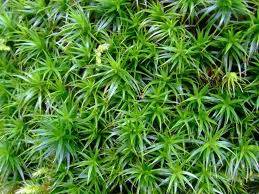
Type 1. Polytrichum Species

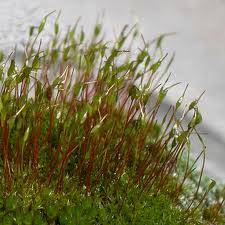
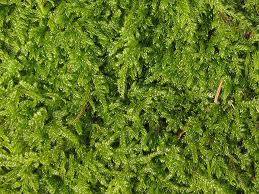
When it comes to moss in lawns there tends to be 3 main types:

Type 2. Caratodon Purpureus & Bryum Species

Type 3. Hypnum & Eurhynchium Species

Treating Moss

Non chemical ways of treating moss would be to scarify your lawn in Autumn. Scrifying is hard raking to pull as much of the moss away from the ground.  You can do this with a long, thin tined rake or if you have a larger garden.