FRESHLY CUT TO ORDER   ·   NATIONWIDE DELIVERY   ·   EXPERT ADVICE

Real Turf v Astroturf

It used to be the case that people always preferred real turf than artificial turf. This is largely still the case but a rise in the sales of Astroturf suggests that many people require the convenience of an artificial lawn. Each have their pros and cons so here Turf Growers analyse which is better for use in home gardens.

There are now several types of artificial turf available on the internet and they have come a long way in terms of looking like genuine grass turf. Artificial lawns are a way to replicate a real lawn in problem areas, such as spaces that are void of sunlight or moisture; hence why they are popular in urban areas and courtyard gardens.

Artificial turf solutions have a life span of generally around 8 years. They are low maintenance and can deal with a fair amount of wear and tear. This means that they are  suitable if you have children or dogs or if you are expecting a high volume of foot traffic across your lawn.

To any keen gardener the concept of laying artificial turf may seem a lot like cheating. This is largely up for deliberation, but despite this it does make for less maintenance work. This said,  it also eliminates the sense of pride gained by conditioning a lawn made from real turf.

Artificial grass is now discernibly more like real grass, but ultimately still does not have the same aesthetic of a real turf lawn. Astroturf lawns also do not have the same feel and many have a synthetic carpet-like touch. Some people love this fabric but it is noticeably not the same texture as real grass.

Installing and maintaining a real lawn may be more effort than an artificial option but it is also cheaper. Artificial turf is much more expensive to purchase initially and a proper artificial lawn will have a base below for drainage which will make an artificial lawn significantly more expensive than a traditional turf lawn. Put the effort into maintaining a natural lawn and you will save the pounds!

When it comes to real turf versus Astroturf it is a relatively level playing field, excuse the pun. A real lawn is cheaper and its natural look is preferred by most to synthetic grass. Whilst genuine turf does require a bigger investment of time it is true that there is undoubtedly nothing like the real thing.

If you struggle to find the time to maintain your lawn or if you have problematic lawn areas artificial turf is a practical alternative to real turf. If, though, you have the time to give your garden diligent care and attention, nothing looks better than a real lawn and you will also save money by using real lawn turf.
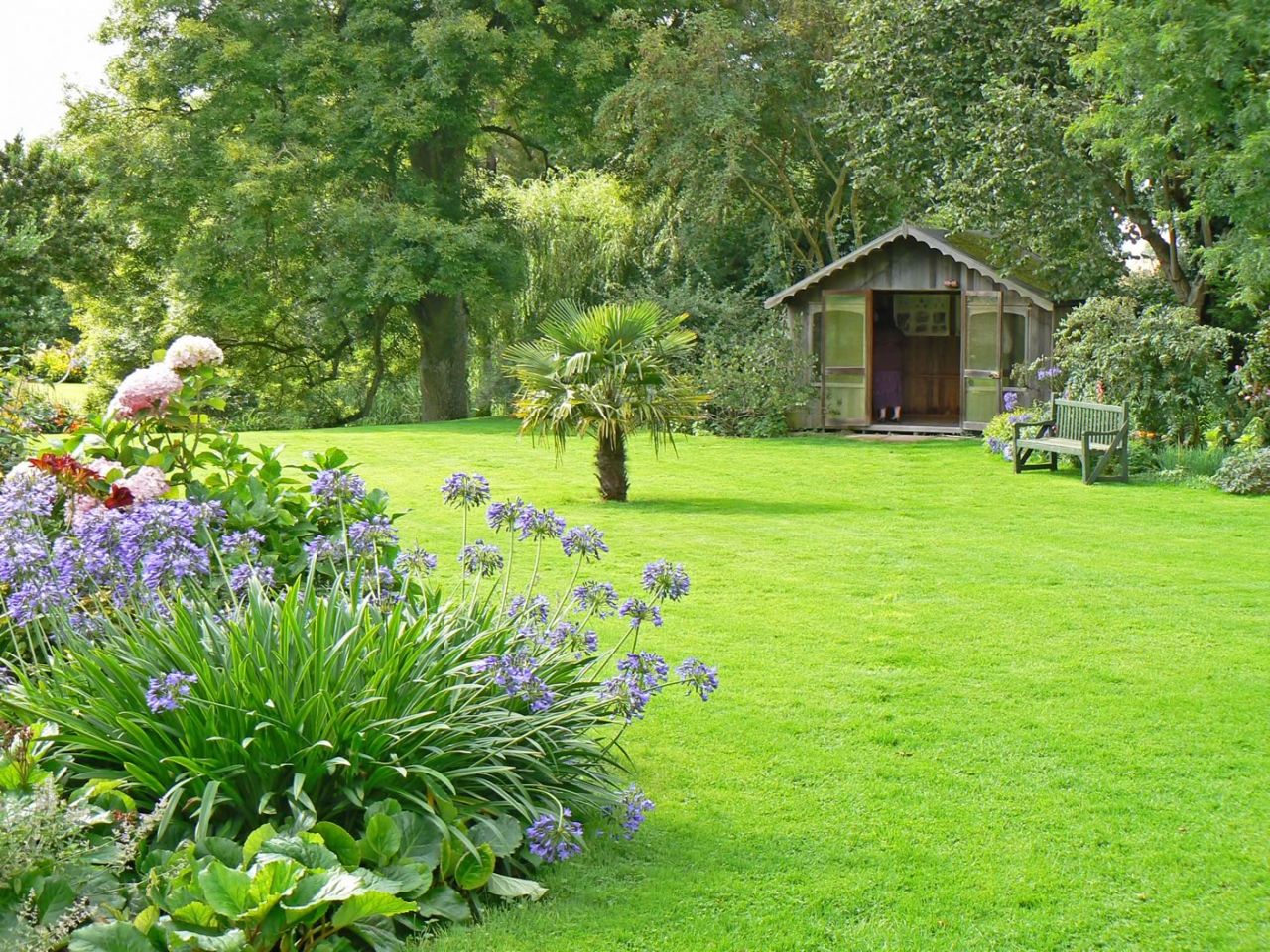
The Importance of Grass!

Grass. It’s everywhere. It’s our garden carpet, it lines our paths, it cushions our children’s falls, it covers sports fields, it’s what makes a park a park, it feeds our livestock and yet grass is taken for granted on a daily basis.

Grasslands cover a massive ¼ of the earth’s land area with over 9,000 different species carpeting mountain peaks, polar regions, savannahs, jungles and making our planet liveable.

Although we do not eat grass, without it, we would lose a massive food source. We can thank grass for the production of rice, corn, oats, sugar, bread, alcohol and so much more. Without grass, many animals would cease to exist.

garden lawn ideas

Amazing Truth About Grass.

Fortunately for us, grass is highly sustainable and practically impossible to destroy. It doesn’t matter whether grass is cut, eaten, flooded, burnt or scorched; the roots will revitalise the grass time and time again.

Despite us not actually eating grass in its basic form, grass is one of our top natural resources and is invaluable to sustaining our love for eating meat, eggs, cheese, yoghurt and milk by providing cattle, sheep, goats, horses, rabbits and poultry with essential nutrients to survive.

Furthermore, grass is Mother Nature’s natural remedy against soil erosion caused by heavy rainfall and high winds. Soil erosion has a massive impact on our natural environment causing crops, farmlands and structures to wash away resulting in the land losing vital nutrients, minerals and fertility.

summer lawn

How To Look After Your Grass.

If you give your grass the love and care that it deserves, you will be rewarded with a luscious green  blanket of blades and be the envy of your neighbourhood. Here’s how;

  • Fertilise: A good organic fertiliser will encourage grass growth, ward off weeds and decrease moisture loss from the soil resulting in a healthy, thick lawn.  The best time of the year to fertilise is spring as it prepares the grass for the summer heat and gets it ready for an increase of use.
  • Mow: Remember that grass uses its blades to transform sunlight into energy allowing the roots to grow stronger producing more grass. With this in mind, never mow your lawn too short. You should aim to have your grass about 5cm tall in spring, and about 10cm in summer so that it gains enough sunlight to feed on but also protects the soil from the heat. Mow weekly taking off very little to see instant success.
  • Spread the Clippings: When you’ve finished mowing your lawn, lightly sprinkle the clippings around to promote moisture and growth. The grass waste works as a natural fertiliser and feeds essential nutrients back into the soil.
  • Weed: Weeds compete with grass for the nutrients in the soil and can quickly take over your lovely lawn. Eliminate weeds from the root by using a trowel or small fork to give your lawn the best possible chance at being healthy.
  • Water: Usually natural rainfall is sufficient enough for healthy lawn growth, however if you are experiencing a dry spell, make sure you water your garden every few days. For best results, do this either early in the morning or later in the day when it is cooler. Watering your grass in extreme sunlight and heat can have very negative effects.

Look after your lawn and your lawn will look luscious.

Choosing the Right Type of Lawn Turf

So you’ve decided to lay a new lawn. You’ve prepared the site, everything is ready, and you just need to buy turf. So off you go to a turf suppliers, but you’re faced with a choice. There are several different types of turf, and no information about which one will be right for you and your garden. So what do you do?

Just read our useful guide to buying lawn turf, and you’ll be confident of choosing the right one for you.

First of all, check how long your turf will be kept rolled up before delivery. Turf is not good rolled up for any length of time, which is why you should always lay it as soon as possible after delivery, and if you can’t do that, at least unroll it. So look for turf that is freshly cut to order the day before delivery.

Choosing your grade of turf.

You need to consider how much wear the lawn will get, and also whether your garden has any particular issues such as shady areas. There are three main types of lawn turf:

1) Family lawn turf

This is a hard-wearing rye grass mix, which means that it should stand up to lots of running around on it and keep its beautiful green colour even with lots of use. It’s also easy to maintain with a little care and attention at the right times of year.  Get a Family Lawn Turf Quote

2) Lawn Master turf

This is generally a little more expensive than family lawn turf, but it is also a bit tougher, and stands up to adverse conditions a bit better. So if you have shady areas, or your garden tends to be a bit dry, perhaps because you have very sandy soil, then this might be a better choice. It recovers well from prolonged dry periods, and is also very hard-wearing, standing up to family use very well. Get a Lawn Master Quote

3) Deluxe turf

This is the top grade of turf, and is sometimes described as ornamental. It’s very fine bladed, so is ideal when you want your turf to look absolutely beautiful, and appearance matters much more than ability to tolerate lots of wear and tear. It’s also resistant to shade, meaning that it’s a good option even in a garden with lots of trees. Get a Deluxe Turf Quote

If you’re still hesitating, don’t forget that lawns are a long-term project. You can always returf or reseed particular areas at a later stage, perhaps even with a different lawn turf or seed mix, if you find you have a problem patch. It’s all a work in progress, but hopefully you’ll now be confident that what you’re buying is not just good quality turf, but also the right turf for your garden.

Planting Trees in Lawns

Planting one or more trees in a lawn is a very good way to break up a large expanse of turf, and also provide some shade and shelter for birds and animals. And, of course, autumn is the best time to plant trees. But how do you go about planting a tree in your lawn?

tree planting

1) Choose and buy your tree

There are a wide range of trees available, in different sizes, so think about what you might want before buying. Things to consider include soil type, size, and aspect, as well as whether you want something evergreen or deciduous, spring flowers, autumn colour, fruit, and so on.

2) Prepare the ground

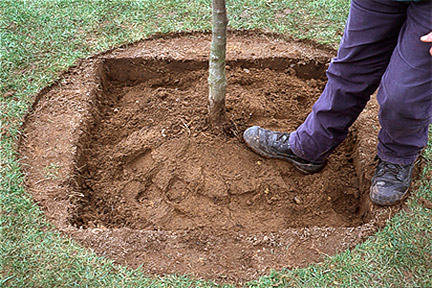
Using an edging tool or sharp spade, cut a square of lawn turf where you want the tree, lever it up and lay it to one side. The hole needs to be big enough to fit your tree’s rootball in, with space all round. You will, ideally, want to bury your tree’s rootball under about 2.5cm of soil, so the depth will need to be rootball, plus 2.5cm, plus enough depth for some well-rotted organic matter such as compost or manure at the base of the hole. To avoid making your lawn very messy, dig the soil out onto a plastic sheet.

3) Settle the tree

Place the tree in the hole, and then fill in the soil. At this stage, it’s good to have a ‘willing helper’ to hold the tree straight for you. They can then step back and tell you if it’s not straight.

4) Cover, mulch and support

The turf that you set aside can now be cut into sections, and fitted back around the base of the tree. Place the turf upside down for  5-10cm all around the tree, to suppress the grass, and give the tree a chance to establish.  Mulch with bark chippings or good quality compost.

A tree that is larger than about adult head height will also need support. For bare-rooted trees, use a single vertical stake about one third of the tree’s height, and make sure it’s about 60cm deep in the soil to anchor the tree properly. Keep it 2.5-3cm away from the tree, and secure them together. Container-grown trees generally need two stakes, on opposite sides, and secured to the tree with long ties.

5) Ongoing care

Water regularly during any dry periods, making sure the soil is wet right down to the roots. You can also help your tree to grow by planting perennial sweet peas around the base, as they provide nitrogen to the tree. Provide a support for the peas of chicken wire loosely around the tree to a height of 30-45cm.

Wildflower Meadows: Pros and Cons

With wildlife gardening currently so popular, and many people asking about wildflower meadows and whether they should convert a section of their lawn to a meadow, we thought it might be helpful to provide a summary of the pros and cons of wildflower meadows, to help you make up your own mind about them.

On the plus side

  1. Once established, wildflower meadows need a lot less work than a traditional lawn. For example, you don’t have to mow wildflower meadows every week during the summer. In fact, you only have to cut them once a year, and you can use a strimmer. So you don’t even need to own a mower!
  1. Wildflower meadows are a real boon to pollinating insects. And where you encourage pollinating insects, you will encourage birds that feed on them. So a wildflower meadow, even a small one, will be great for the local wildlife, and you will be doing your bit to ‘Give a Home to Nature’.
  1. Perennial meadow species don’t even like fertile soil, so having a wildflower meadow is a really good choice if your soil is thin and infertile, and not very good for traditional lawn turf. Meadows are also more drought-resistant than turf.
  1. Some turf suppliers can even sell you ready-made wildflower meadow turf: just unroll it and lay it as you would traditional turf, and away you go!

On the down side

  1. Perennial wildflower meadows can look a bit messy compared with a traditional lawn. Because the grass can get quite long, they’re not exactly places to sit in a deckchair and admire your manicured garden! So if you want that kind of garden, look away now.
  1. You really need quite a lot of space for a wildflower meadow. If your chosen area is too small, the plants will constantly be seeding outside your meadow area, and you will be getting cross about having ‘weeds’ elsewhere!
  1. Although it’s technically quite easy to sow a wildflower meadow, it can be quite difficult to get one established. Even if all the flowers grow in the first year or two, the grasses tend to take over if unsuppressed. And it’s not entirely trivial to get the flowers to grow either: many gardeners have ended up concluding that bindweed and nettles also count as native wildflowers in order to justify their constant presence in the new meadow! Lawn turf, on the other hand, is readily available to buy from turf suppliers, and can be replaced if necessary.

Wildflower meadows clearly have some big advantages, but also some downsides. Whether you want to have a go at establishing one, or whether you stick to traditional lawns, is up to you!

Autumn Maintenance of a Wildflower Meadow

Increasingly, many gardeners are choosing to develop part of their lawn as a wildflower meadow, as well as keeping some as a beautiful patch of lawn turf. So we thought that, as well as providing advice about autumn maintenance of lawns, we should also provide a little guide to maintaining a perennial wildflower meadow.

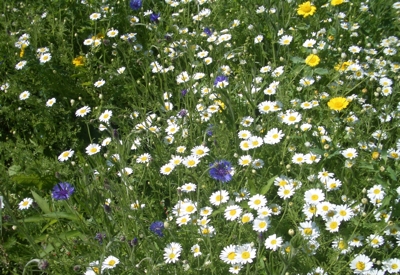
Meadows only really need to be cut once a year. When you cut a perennial wildflower meadow depends on the type of plants and flowers within it, since you basically need to cut it when flowering has finished. So if you have spring flowering perennials, then you need to cut it around July, and with summer-flowering perennials, you should cut it in August or September. However, whatever your type of meadow, the process is more or less the same.

wild flower meadow

The best time to cut your meadow is during a dry spell, when it has not rained for a while. Not only will the grass be easier to cut, but the seed will disperse more readily, which is what you want, as it will spread your perennial species around the meadow area. The grass will be too long for a mower, so you will need to use a strimmer for small areas. For large areas, you’ll probably want to use a sickle-bar mower or  motor scythe.

Once cut, leave the mowings in place for a few days, to allow the seed to disperse fully. Then rake up all the mowings and clear them. This will ensure that they don’t rot in place, and provide too much nitrogen for the soil. Perennial meadow species don’t really like very fertile soil, so you don’t want to increase fertility if you can avoid it!

At the same time, you’ll need to remove weeds, especially perennial weeds like nettles and bindweed. Either dig them out by hand, with a long thin trowel designed for the purpose, or use a spot herbicide like glyphosate, which will kill them down to the roots.

wildfower turf

The overwhelming problem that most perennial wildflower meadows suffer is that they tend to become dominated by grass and not wildflowers. There are two main ways to combat this:

  1. Sow yellow rattle (Rhinanthus minor) seed throughout the meadow. This species is semi-parasitic on grass, so it will reduce the vigour of the grass, and give your flowers a chance to grow.
  1. Re-seed your meadow each year with any species that have not grown very well, or that you seem to be losing. Alternatively, buy and plant plugs of the relevant species in small groups, and they will then hopefully seed and spread themselves around.

Hopefully this little guide to managing your perennial wildflower meadow will help you keep it flourishing, and supporting local wildlife.

Lawns for Wildlife

The Royal Society for the Protection of Birds has launched a new initiative, called ‘Giving Nature a Home’, designed to encourage gardeners to think about wildlife in their gardens. The thinking behind the campaign is that as ‘wild’ habitats disappear in favour of housing, gardens become ever more important as a potential resource for wildlife. And since lawns often take up quite large parts of gardens, they’re well worth thinking about if you want to make your garden wildlife-friendly. So what can you do to make your lawn part of a nature-friendly garden?

lawn for wildflower

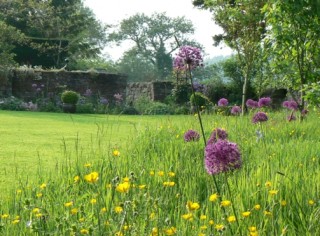
First, don’t try to kill all the weeds, especially not using chemicals. A bit of clover or a few daisies in amongst your lawn turf will be great for bees and other nectar-loving insects! And where insects come, other wildlife will follow. If you have a large area of lawn, you might even consider leaving part of it unmown, or perhaps making a maze or decorative feature with longer areas. The longer grass will provide shelter for bugs and larger animals such as toads, especially if you also have damp areas around your garden. Leaving your lawn to grow long in this way will also give you fewer problems during periods of drought.

Or how about having a lawn with a difference? You could either have a wildflower meadow, or perhaps a sedum lawn. Both of these will be rich in nectar for pollinating insects, and are also more drought resistant than a traditional lawn. We’re not going to pretend that either is a no-maintenance option, as both need some care, but they probably are slightly lower maintenance than traditional lawn turf.

A wildflower meadow can either be annual or perennial. Annual meadows are probably the easiest, as you can buy a packet of wildflower seeds, and seed it onto your existing lawn, as you would with grass seed. Prepare the ground first and then cover the seed with topsoil, and net it to prevent birds eating all the seeds. You may need to reseed annually, although some species will seed themselves.

A sedum lawn provides an interesting alternative to grass, although they have not really caught on in a big way. But perhaps if summers do become hotter and drier, as some experts are predicting, we will see more, as sedum is very drought-tolerant. Low-growing and gentle spreading, they are ideal ground cover plants, and may even be the lawns of the future. Who knows? But a patch of sedums, even if not a whole lawn, will provide nectar for insects and so make your lawn more wildlife-friendly.

We hope these ideas will help you think a bit about how to give nature a home in your garden, including using your lawn.

Hose Pipe Ban Update

watering turf

21st May Update

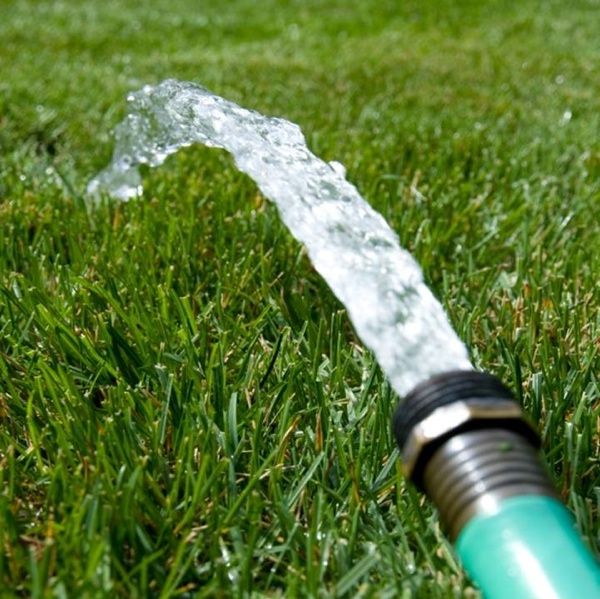
The Hosepipe Ban restrictions have been lifted by Thames Water for landscape and gardening firms and for the watering of new turf and plants for upto 28 days after planting / turf laying.

The relaxation of the hosepipe ban only applies for upto 28 days after turf laying or planting.

The areas covered by Thames Water include: large parts of London, Thames Valley, Surrey, Kent, Wiltshire and Gloucestershire.

Don't forget that you dont always need a hose pipe to water turf, it can be done with watering cans and why not try recycling your water.. check out our blog article on Laying Turf During a Hose Pipe Ban and Looking after Your Lawn in a Drought.

Hose Pipe Ban

The current hose pipe ban has been getting a lot of press recently and we the public are sceptical after we experienced the wettest April on record with 13 flood warnings and more rain predicted for May.

Hopefully this article will give you a brief overview of what exactly is going on with the hosepipe ban, where and who it's affecting and what you can do to help.

The rain in Summer is largely taken by plants and evaporation.

The current ban is affecting approximately 20 million people in the UK in and around the South and East.  The rain we needed simply didn't fall during our last 2 winters when the ground levels are usually replaced.  Then during April of this year we had some of the heaviest rain in over 100 years which is good news for farmers, gardeners, fish and wildlife in rivers but we we still need more water to cover the depleted stocks from the last two years of dry weather.

May is set to be another wet month but water companies will still have to keep their hose pipe ban in place for now and for most of the year. Recently raised was the subject of Standpipes. A water standpipe is a pipe connected to the local water supply. On the end it has a tap, which people can use to get fresh water from the local supply. If introduced, water supplies to properties would be cut and people expected to source their water from these communal stand pipes. They have not been used since 1976. Environment Secretary Caroline Spellman said “Whereas it’s most unlikely we’d have standpipes this year, if we have another dry winter that becomes more likely.”

The rain we experienced in April was only enough to give our stocks a short term boost.

The areas affected are:

It is said that anyone ignoring the ban faces a fine of up to £1000 but we can all do our bit to help; check out our ten tips of reducing the amount of water we use:

  1. When washing hands, teeth and dishes turn OFF the tap instead of keeping it running.
  1. Run dish washer and washing machine only when full; you can save so much water this way.
  1. Plant plants in the spring instead of summer.
  1. Spread a layer of organic mulch around plants to keep moisture locked in.
  1. Use a broom instead of hose pipe to clean driveways.
  1. Shortening your shower by only one minute will save up to 150 gallons of water a month.
  1. Collect water from your house, garden sheds and garage roofs to use on the garden.
  1. If you are able to use a hose pipe & watering a large area such as lawn or vegetable plot, spray on water in short intervals stoppping the water for at least 5 minutes in between watering preventing any excess water running off the area.
  1. If you wash your car at home, wash it on the lawn so watering garden at the same time.
  1. If a family of four replace their inefficient shower head with a water-efficient one they could save around £72 off their gas bills and around £72 off their water bills (if they have a water meter) each year. That’s a total saving of £150.